Content Formats
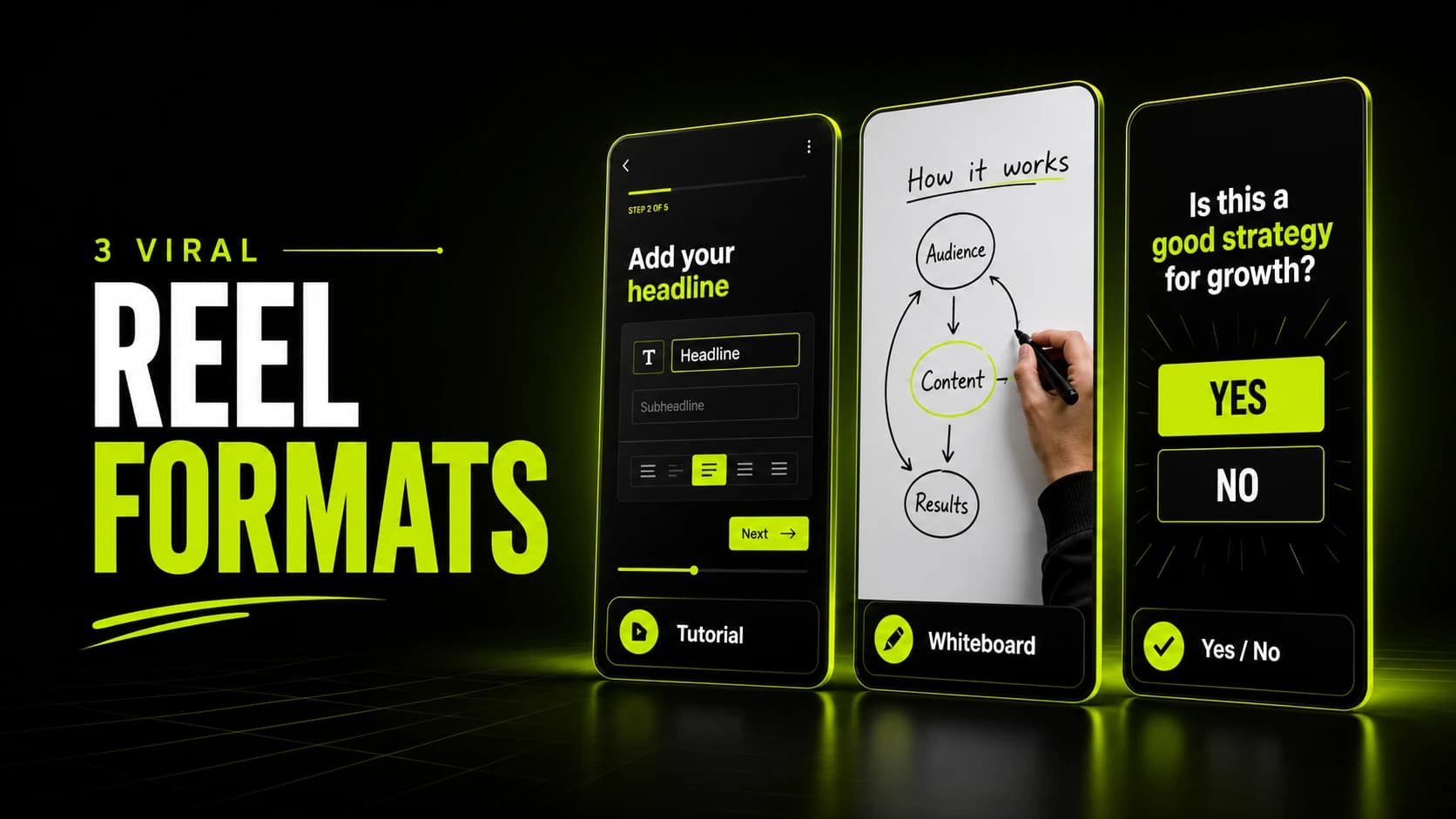
3 Viral Reel Formats That Make Educational Content Easier to Watch
Educational content should be easy to watch.
That sounds obvious, but most brands get it wrong.
They take a useful idea and package it like a lecture. Too much context. Too many points. No pacing. No visual structure. No reason to keep watching after the first five seconds.
The problem usually is not the information. It is the format.
At Brightwing, when we create educational content for clients, we do not just ask, "What should we teach?" We ask, "What format will make someone want to keep watching this?"
That difference matters.
01
Clickable Tutorial Guide
The Clickable Tutorial Guide is built for topics that have multiple steps, subtopics, or related pieces of content.
Instead of trying to explain everything in one Reel, you use the Reel as a guide. It points viewers toward the next thing they should watch, read, save, or try.
For example:
- Watch this if you do not know your content pillars.
- Watch this if your hooks are weak.
- Save this if your carousels get no saves.
- Send this to your editor if your Reels feel slow.
- Download this if you want the full format list.
The reason this works is that it lowers the mental load. The viewer does not have to figure out where to start. You organize the learning path for them.
We used this type of thinking with Stitch Space, a platform for sewing patterns. The audience did not just need random sewing tips. They needed clear, practical guidance they could use immediately.
So the content mix included Reels, carousels, single-image posts, and tutorial-style content. The result was a stronger educational content ecosystem that helped generate 343K+ views and convert followers into early users.
The lesson: do not make every educational post carry the full burden. Sometimes the best educational Reel is the one that tells people exactly where to go next.
02
Whiteboard Explainer
Some ideas are too abstract to explain casually. They need structure.
The Whiteboard Explainer format works because it gives the viewer a visual map while you talk. The creator stands beside a whiteboard and breaks down a concept into clear points.
A strong Whiteboard Explainer might cover:
- The 3 types of content every brand needs
- Why your Reels get views but no leads
- The content funnel we use before scaling an account
- How to turn one customer question into 10 posts
- The difference between reach content, trust content, and conversion content
This format is especially strong for founders, consultants, coaches, and technical experts because it makes expertise visible.
For David Moller's LinkedIn content, the challenge was not just consistency. The niche was technical, and the content had to feel credible. We needed formats that could make complex industry ideas easier to understand without oversimplifying them.
That kind of structured content helped support 800K+ LinkedIn impressions in 2024.
The Whiteboard Explainer works because it signals clarity. The viewer feels like they are learning from someone who has thought deeply about the topic.
03
Rapid-Fire Yes or No
The Rapid-Fire Yes or No format is one of the simplest ways to make educational content feel fast.
Instead of explaining one idea slowly, you answer a series of related questions with quick yes/no responses and short reasoning.
Example:
- Should every brand post Reels? No.
- Should every brand test Reels? Yes.
- Should carousels still be part of your strategy? Yes.
- Should you copy viral formats exactly? No.
- Should you adapt viral formats to your niche? Yes.
- Should you scale a format after one good post? No.
- Should you look for repeated signals before scaling? Yes.
This format works because it creates rhythm. Every few seconds, the viewer gets a new prompt. That keeps the Reel moving and makes the information easier to process.
It is especially useful when your audience is overwhelmed by conflicting advice. Health brands can use it to bust myths. Coaches can use it to answer common client questions. Agencies can use it to challenge lazy marketing advice.
The key is to keep the answers sharp. If every answer turns into a long explanation, the format loses its punch.
Why These Formats Work
The best educational content is not just informative. It is packaged for attention.
That means the structure has to help the viewer:
- Understand the point quickly
- Know why it matters
- Stay engaged long enough to learn
- Remember the idea after the video ends
- Take a next step
Clickable Tutorial Guides work because they organize the learning path.
Whiteboard Explainers work because they make complex ideas feel structured.
Rapid-Fire Yes or No Reels work because they create speed and clarity.
The goal is not to chase formats because they are trending. The goal is to find format-market fit.
The Brightwing Takeaway
If your educational content is not performing, do not immediately blame the topic.
Ask a better question: "Is this idea packaged in the easiest format to watch?"
A strong insight can disappear inside the wrong structure. But when the format fits the idea, educational content becomes easier to watch, easier to save, and easier to share.
Start with these three:
- Clickable Tutorial Guide for connected learning paths
- Whiteboard Explainer for structured frameworks
- Rapid-Fire Yes or No for fast myth-busting
Then test, measure, and scale what your audience responds to.
Free cheat sheet
Want the full list of viral formats?
Download Brightwing's Top 12 Viral Formats cheat sheet and steal the exact structures for your next short-form video.
Get the cheat sheet